

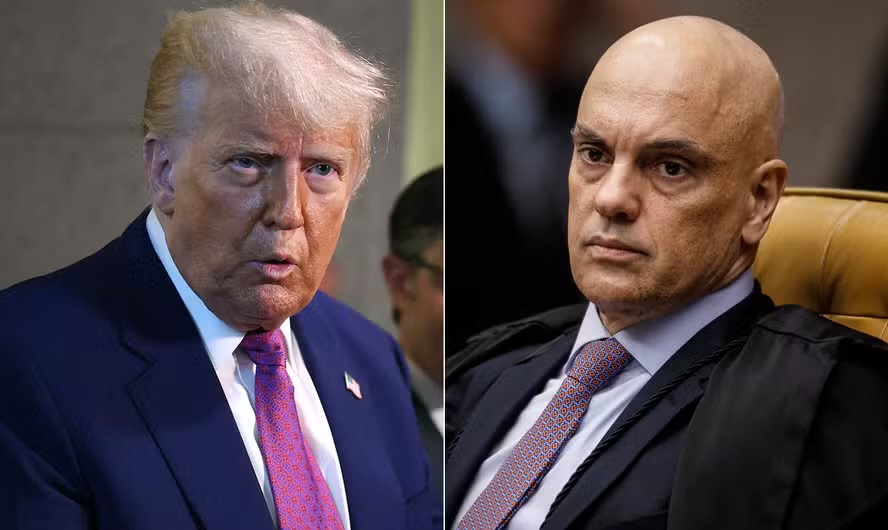

American Justice Strikes Back: Trump Media and Rumble Take on Brazil’s Rogue Judge Alexandre de Moraes
By Hotspotnews
In a bold stand for free speech and American sovereignty, a U.S. federal court in Florida has advanced a landmark lawsuit brought by President Donald Trump’s media company and the video platform Rumble against Brazilian Supreme Court Justice Alexandre de Moraes. The case exposes the dangerous overreach of foreign judicial activists who believe they can censor Americans and dictate terms to U.S.-based platforms from thousands of miles away. Senior Trump advisor Jason Miller captured the moment perfectly with his trademark wit, warning Moraes that “the walls are closing in” and quipping that the judge would “look great in an ankle bracelet and under house arrest.”
This isn’t just another legal skirmish—it’s a critical battle in the global fight against leftist authoritarianism masquerading as justice. For years, Moraes has wielded unchecked power in Brazil, suspending accounts, issuing gag orders, and targeting conservative voices, journalists, legislators, and even entertainers critical of President Luiz Inácio Lula da Silva’s leftist government. His orders have repeatedly crossed borders, demanding that American companies like Rumble and Trump Media & Technology Group (TMTG) block content visible to users in the United States, in direct violation of the First Amendment.
The lawsuit, filed in February 2025 in the U.S. District Court for the Middle District of Florida, pulls no punches. Trump Media and Rumble argue that Moraes’ “gag orders” censor legitimate political discourse on U.S. soil, targeting critics of the Brazilian regime—including supporters of former President Jair Bolsonaro, a key Trump ally. These actions aren’t neutral law enforcement; they represent extraterritorial coercion aimed at silencing dissent and exporting Brazil’s politicized judiciary to American shores.5
Recent developments have conservatives cheering. On May 22, 2026, the Florida court greenlit service of the summons via email to Moraes, bypassing Brazil’s shielding tactics. If the judge fails to respond promptly, the plaintiffs can seek a default judgment—further underscoring the lack of transparency and accountability in Brazil’s judicial process. This ruling forces Moraes to confront the case on U.S. turf, where he must defend against claims of First Amendment violations, breaches of the Communications Decency Act, and conflicts with Florida and U.S. public policy. No more hiding behind diplomatic immunity or foreign sovereignty claims while trampling American rights.6
Jason Miller, a longtime Trump warrior and communications powerhouse, didn’t hold back in his viral post. “Uh-oh, @Alexandre de Moraes! The walls are closing in!!!” he wrote. “Maybe it wasn’t such a good idea to ban Trump Media and Rumble in Brazil???” Miller highlighted how this fight reveals deeper issues: a politicized Brazilian judiciary, opaque processes, and outright attempts at global censorship. His sarcastic jab about the ankle bracelet hits hard—especially given Moraes’ own history of imposing such restrictions on political opponents, including house arrest measures against Bolsonaro himself. Turnabout is fair play when American courts defend liberty.0
The Bigger Picture: Lawfare Against Conservatives
Conservatives have long warned about the weaponization of institutions against populist movements. In Brazil, Moraes embodies this threat. Since at least 2022, he has suspended nearly 150 accounts, often without due process, focusing on right-leaning figures who challenge the establishment. This mirrors tactics seen elsewhere: lawfare to sideline opponents, big tech pressure to enforce narratives, and erosion of democratic norms under the guise of combating “disinformation” or “threats to democracy.”
President Trump’s companies standing up to this sends a powerful message. Truth Social and Rumble were built as alternatives to Big Tech censorship—platforms where free expression thrives without Silicon Valley overlords or foreign judges playing thought police. By suing in Florida, they are asserting that U.S. law prevails on U.S. servers and for American users. This case could set vital precedents on international comity, platform immunity, and the limits of foreign judicial power.
The timing is no coincidence. With Trump back in the White House, America is reasserting leadership against globalist intimidation. Moraes’ actions aren’t isolated; they reflect a broader leftist alliance that seeks to control information flows worldwide. From European digital services regulations to Brazilian crackdowns, the pattern is clear: suppress conservative voices, protect entrenched power, and label dissent as dangerous.
A Victory for Sovereignty and Free Speech
This Florida ruling is more than procedural—it’s a moral and constitutional win. It tells the world that the United States will not bow to foreign demands that undermine our Bill of Rights. American companies shouldn’t be forced to play censor for authoritarian-leaning judges abroad. Users in Florida, Texas, or anywhere in America deserve protection from such overreach.
As Miller noted, if Moraes shows up in court, he’ll have to litigate jurisdiction and enforceability here, where transparency and rule of law still matter. If he dodges, a default judgment looms, amplifying the case’s impact. Either way, the momentum favors liberty.
Conservatives understand what’s at stake: the defense of national sovereignty against transnational progressive activism. Jason Miller’s sharp commentary reminds us that fighting back—with humor, resolve, and legal firepower—yields results. President Trump built platforms like Truth Social precisely to counter this nonsense. Now, his team is taking the fight international.
The message to rogue actors like Alexandre de Moraes is unmistakable: You don’t get to censor Americans. The walls are indeed closing in on unchecked judicial tyranny. And in the land of the free, justice—real justice—prevails.