

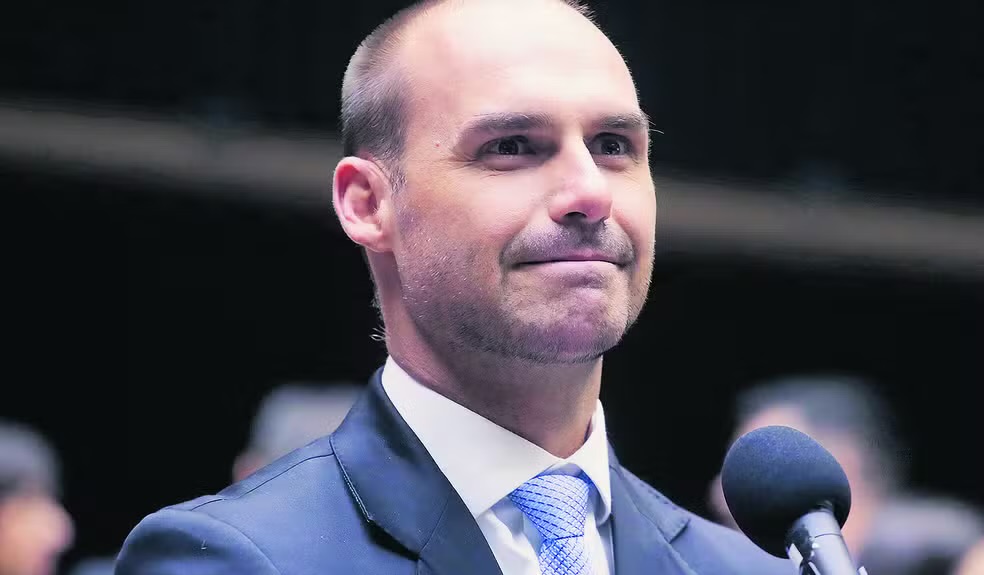

Eduardo Bolsonaro: A Wake-Up Call for Conservative Unity Against Global Leftism
By Hotspotnews
In a riveting appearance on Rudy Giuliani’s “America’s Mayor Live,” Eduardo Bolsonaro, son of former Brazilian President Jair Bolsonaro, delivered a powerful message that resonates deeply with conservatives worldwide.
This interview wasn’t just a casual chat; it was a strategic geopolitical signal aimed squarely at American conservatives, framing Brazil’s turbulent political landscape as a frontline in the broader battle against leftist authoritarianism. By drawing parallels between Brazil’s struggles and those in the United States, Eduardo highlighted how internal divisions in Latin America are being exploited by global forces, particularly China, to undermine Western values and security. As conservatives, we must recognize this as a clarion call for renewed alliances to protect freedom, sovereignty, and traditional principles.
The discussion centered on three pivotal arguments that expose the insidious tactics of the global left. First, Eduardo articulated the existence of a “global leftist manual” – a playbook that weaponizes judicial overreach and digital censorship to silence opposition. He drew direct comparisons to the United States, where conservatives have long decried the politicization of institutions like the DOJ and Big Tech’s suppression of free speech. In Brazil, this manifests through the Supreme Court’s aggressive actions against Bolsonaro supporters, including arbitrary bans on social media and legal persecutions that echo the witch hunts against President Trump. Eduardo’s analysis is spot-on: this isn’t isolated; it’s a coordinated effort to erode democratic norms under the guise of “protecting democracy.” Conservatives know this all too well – it’s the same strategy that turned January 6 into a perpetual smear campaign while ignoring Antifa’s riots.
Second, the interview delved into hemispheric security threats, painting a grim picture of how criminal organizations like Brazil’s Primeiro Comando da Capital (PCC) and Venezuelan-linked drug cartels are destabilizing the region. Eduardo emphasized that these groups aren’t just local nuisances; they’re proxies in a larger proxy war, fueled by instability in Venezuela under socialist rule. He called for a strong US-Brazil alliance to combat these threats, invoking the Monroe Doctrine’s spirit to keep foreign adversaries at bay. From a conservative viewpoint, this is essential: unchecked cartels flood our borders with drugs and crime, weakening national security. Eduardo’s plea underscores how leftist policies in Latin America create vacuums that criminals and tyrants exploit, directly impacting American families ravaged by fentanyl and border chaos.
Third, and perhaps most alarmingly, Eduardo spotlighted Brazil’s deepening economic ties with China as a strategic vulnerability. Under the current leftist administration of President Lula da Silva, Brazil has pivoted toward Beijing, trading away independence for short-term gains in commodities and infrastructure. This dependency, Eduardo argued, poses a direct risk to American interests, as China uses economic leverage to expand its influence in Latin America, much like its Belt and Road traps in Africa and Asia. Conservatives have warned about this for years – China’s communist regime isn’t a benign partner; it’s a predator aiming to supplant U.S. leadership. By aligning with China, Brazil risks becoming a pawn in the US-China rivalry, exacerbating regional tensions and empowering anti-Western forces.
The interview also touched on personal stakes, referencing the recent assassination attempt on Jair Bolsonaro and the ongoing legal battles against his family. These aren’t mere domestic squabbles; they’re symptoms of a legitimacy crisis engineered by the left to delegitimize conservative leaders. Eduardo’s narrative elevates Brazil to a symbolic battleground, where the fight against judicial tyranny and socialist overreach mirrors global conservative resistance. It’s a reminder that when conservatives stand firm, as Bolsonaro did against election fraud allegations and COVID mandates, they inspire movements everywhere.
So, how does this affect Brazil? Profoundly and perilously. Domestically, it intensifies the divide between conservatives who champion free markets, family values, and law and order, and the leftist establishment that prioritizes globalist agendas over national sovereignty. Eduardo’s outreach to U.S. conservatives could galvanize international support, potentially pressuring Brazil’s judiciary and media to ease their crackdowns. Economically, highlighting Chinese dependence might spur a reevaluation of trade policies, encouraging Brazil to strengthen ties with reliable allies like the U.S. rather than authoritarian regimes. Geopolitically, it positions Brazil as a key player in countering leftist advances in Latin America, from Venezuela’s Maduro to Argentina’s challenges. If ignored, Brazil risks sliding deeper into authoritarianism, with ripple effects that embolden similar tactics in the U.S. and beyond.
In the end, Eduardo Bolsonaro’s interview is more than words – it’s a blueprint for conservative action. It reminds us that the fight for freedom isn’t confined to borders; it’s a unified stand against the global left’s erosion of liberty. As conservatives, we must heed this call, fostering alliances that protect our shared values and secure a prosperous future for both Brazil and America.