

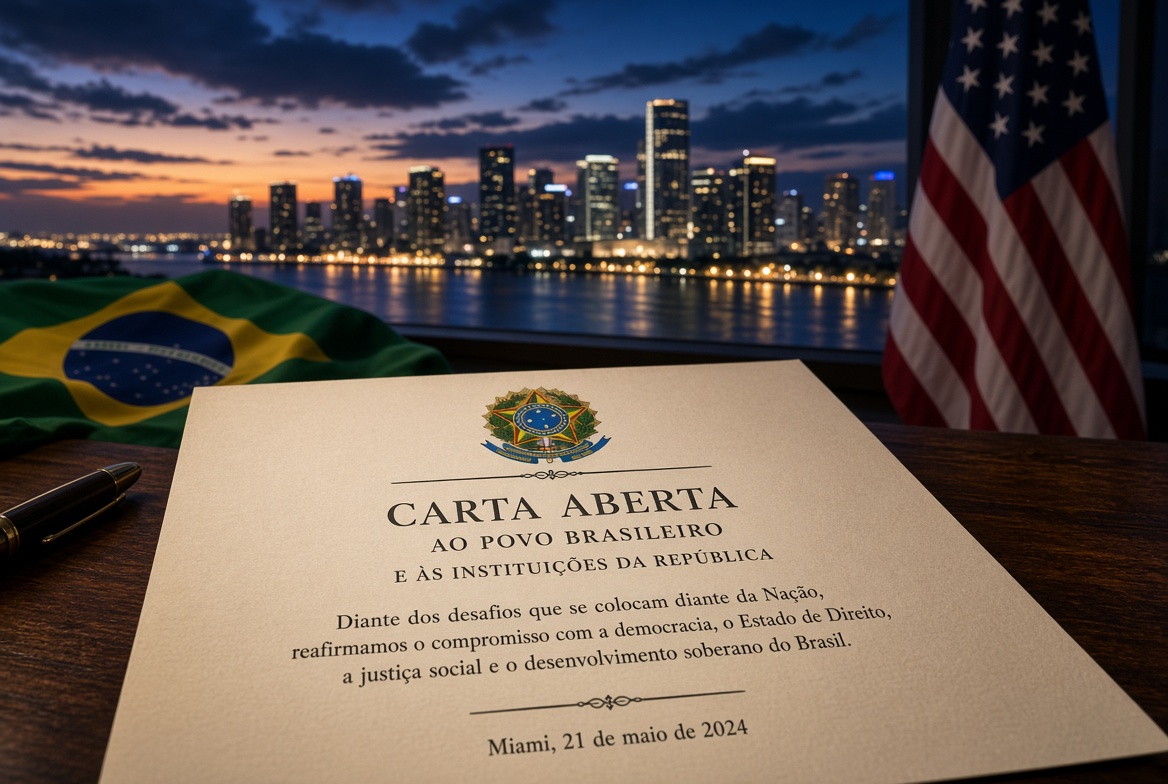

Flávio Bolsonaro Declares Himself Legitimate President-Elect From Miami, Vows to Lead Opposition Against What He Calls a Stolen Election and Judicial Tyranny
By Hotspotnews
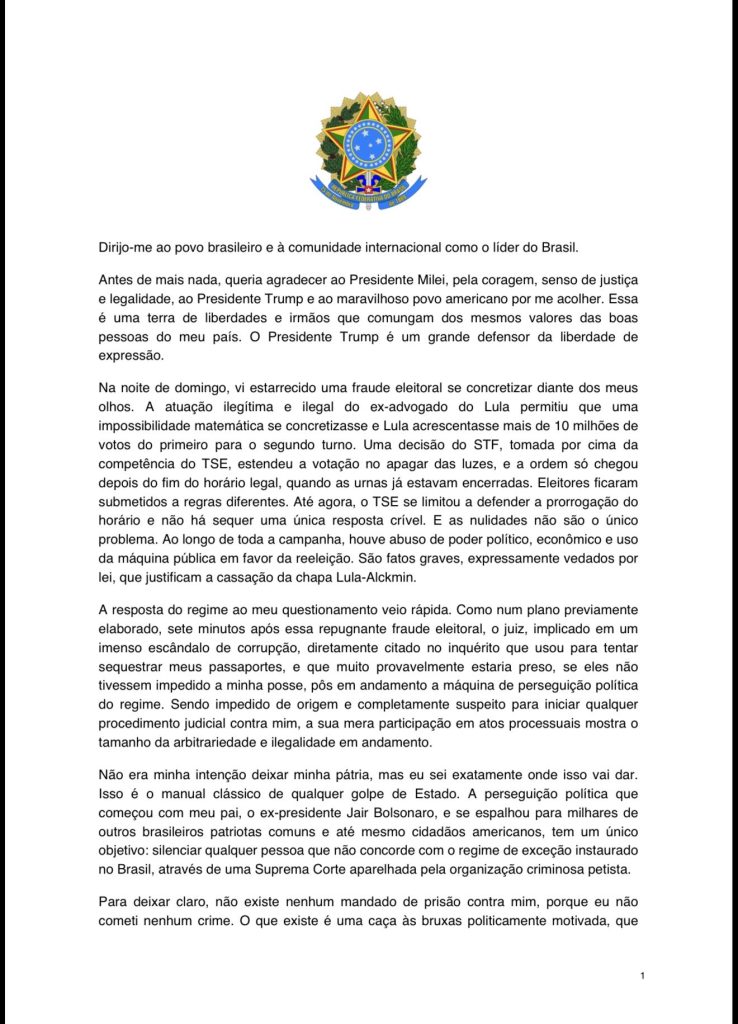
On October 28, 2026, hours after landing in Miami with his family, Brazilian senator and defeated presidential candidate Flávio Bolsonaro released an open letter addressing the Brazilian people and the international community. In the original version of the document, he identified himself as “the true elected president of Brazil,” alleged massive electoral fraud in the October 25 runoff, and framed his departure from the country not as flight but as a necessary step to continue leading the opposition from exile.
The letter opens with formal, ceremonial language typical of official addresses. Bolsonaro thanks Argentine President Javier Milei for his “courage, sense of justice and legality” and U.S. President Donald Trump, along with the American people, for welcoming him. He describes the United States as “a land of freedoms” whose people share “the same values as the good people of my country,” and singles out Trump as “a great defender of freedom of expression.”
The core of the document is the fraud allegation. Bolsonaro states he watched “stunned” as electoral fraud took shape. He claims the illegitimate and illegal action of Lula’s former lawyer enabled a “mathematical impossibility,” allowing Lula to add more than 10 million votes between the first and second rounds. He points to a Supreme Federal Court (STF) decision, taken above the competence of the Superior Electoral Court (TSE), that extended voting “at the extinguishing of the lights.” According to the letter, the order arrived after the legal closing time, when the electronic urns had already been closed, subjecting voters to different rules. He also alleges broader abuse of political and economic power and the use of the public machine in favor of Lula’s re-election, which he says justifies the cassation of the Lula-Alckmin ticket.
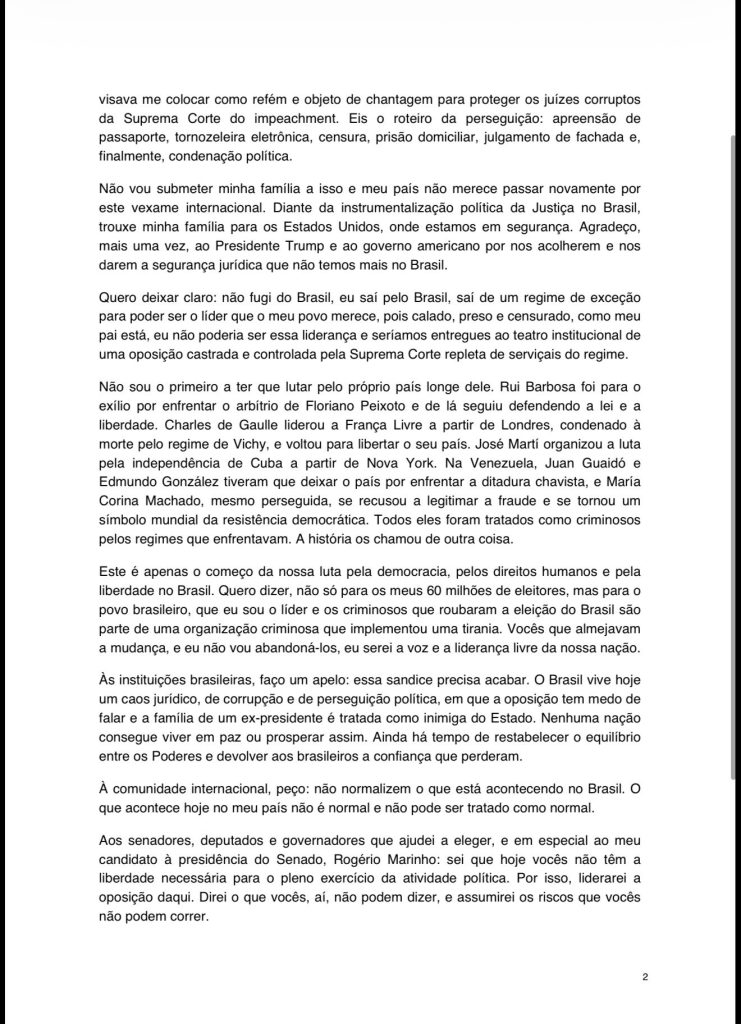
Bolsonaro then describes the institutional response as the “classic manual of any coup d’état.” He lists a sequence: seizure of passports, electronic ankle monitor, censorship, house arrest, a facade trial, and finally political condemnation. He insists there is no arrest warrant against him because he committed no crime, characterizing the proceedings as a “politically motivated witch hunt” designed to hold him hostage and protect corrupt STF judges from impeachment. He notes that the persecution that began with his father, former President Jair Bolsonaro, has extended to thousands of ordinary patriotic Brazilians and even American citizens, with the sole objective of silencing disagreement under a “regime of exception” installed by an STF “packed with servants of the regime.”
On his departure, Bolsonaro is explicit: “I did not flee Brazil, I left for Brazil.” He left a regime of exception so he could be the free leader his people deserve, rather than remaining silenced, imprisoned, and censored like his father. He compares his situation to historical figures who led resistance from abroad: Rui Barbosa under Floriano Peixoto, Charles de Gaulle leading Free France from London, José Martí organizing Cuban independence from New York, and Venezuelan leaders including Juan Guaidó, Edmundo González, and María Corina Machado, whom he praises for refusing to legitimize fraud. “All of them were treated as criminals by the regimes they faced. History called them something else.”
He reaffirms that he is the elected president and that those who “stole the election” are part of a criminal organization that has implemented a tyranny. He promises not to abandon the roughly 60 million voters who supported him and declares himself “the free voice and leadership of our nation.” He appeals to Brazilian institutions to end the “madness,” restore the balance of powers, and return confidence to the people. To the international community he asks that they “not normalize what is happening in Brazil.” To senators, deputies, and governors he helped elect—especially his Senate leadership candidate Rogério Marinho—he offers a division of labor: he will lead the opposition from abroad, say what those inside cannot say, and assume the risks they cannot run.
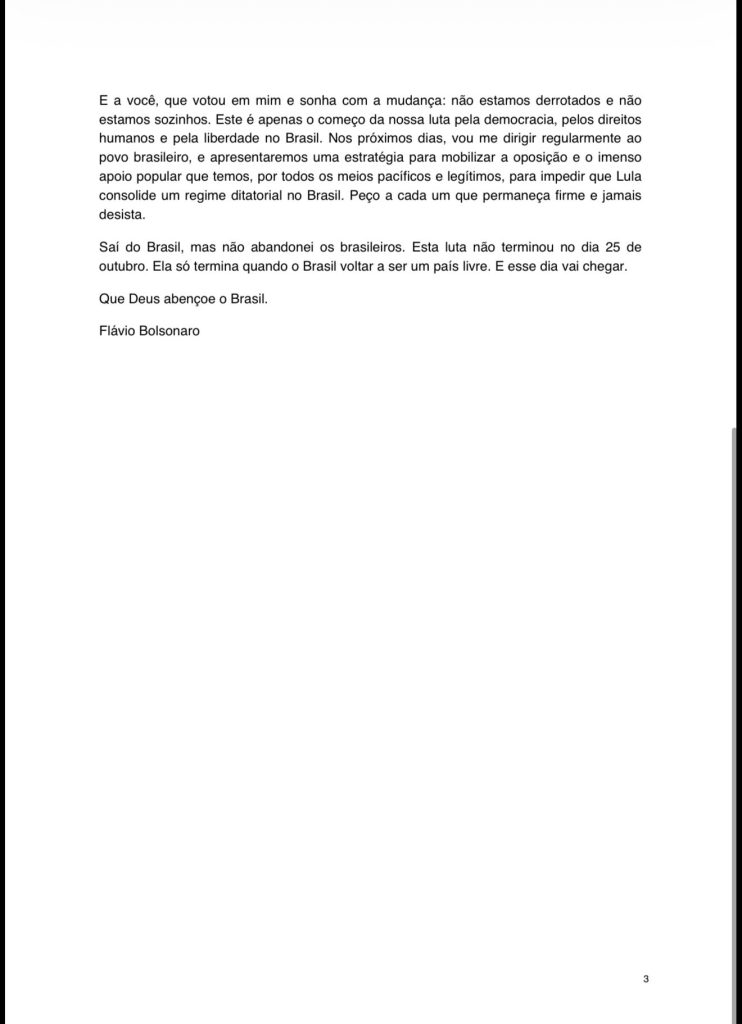
The letter closes with a call to supporters: “We are not defeated and we are not alone.” He pledges regular addresses to the Brazilian people and the presentation of a strategy to mobilize the opposition and popular support by all peaceful and legitimate means to prevent Lula from consolidating a dictatorial regime. “I left Brazil, but I did not abandon the Brazilians. This fight did not end on October 25. It only ends when Brazil is once again a free country. And that day will come. May God bless Brazil.”
Bolsonaro later revised and republished a version of the letter in which the explicit self-declaration as president-elect was softened to “leader of Brazil” and “free voice and leadership of our nation,” while retaining the core allegations of fraud, persecution, and the commitment to lead opposition from the United States. Brazilian media outlets across the spectrum reported the original text and the subsequent edit. International coverage, including from Reuters, noted that he provided no evidence for the fraud claims and that international observers had assessed the vote as fair. Lula was re-elected by a margin of approximately 4.4 million votes. Bolsonaro’s departure occurred after he refused to surrender his passports pursuant to an STF order in connection with an ongoing investigation into alleged money laundering, which he has denied. U.S. authorities granted visas to him and his family; Argentine authorities facilitated the initial border crossing.
The letter places Flávio Bolsonaro’s situation in a broader pattern that many Brazilian conservatives have long argued: the progressive expansion of judicial power under the STF, particularly under ministers associated with the current governing coalition, has constrained political speech, opposition activity, and due process. By relocating to Miami, securing U.S. protection, and publicly aligning with Trump and Milei, he is positioning the Brazilian opposition within an international network of right-leaning governments that have criticized judicial overreach and defended freedom of expression. Whether the specific fraud allegations can be substantiated remains a matter for Brazilian electoral courts and any future international scrutiny; as of the letter’s release, they rest on the candidate’s assertion and the procedural timeline of the voting extension rather than on published audit data or court-validated irregularities.
The document’s rhetorical strategy is clear. It converts legal processes into a “coup manual,” departure into patriotic duty, and electoral defeat into the beginning of a longer resistance. It offers elected allies a protective role while reserving the freest speech for the leader outside the country’s jurisdiction. For supporters, it supplies continuity and a promise of further mobilization. For critics, it constitutes an unproven challenge to the certified result and an attempt to internationalize a domestic political dispute. The revised version’s retreat from the full presidential claim suggests an awareness of the legal and diplomatic risks of the original wording, even as the underlying narrative of institutional capture and the need for external leadership remains intact.
#Brazil #FlavioBolsonaro #Lula #STF #ElectoralIntegrity #Miami #Trump #Milei #Opposition #FreedomOfSpeech #BrazilElections2026 #JudicialOverreach #BolsonaroFamily #DemocracyInBrazil #PoliticalExile #RuleOfLaw #ConservativeBrazil #InternationalSolidarity #FreeBrazil #October2026Election