

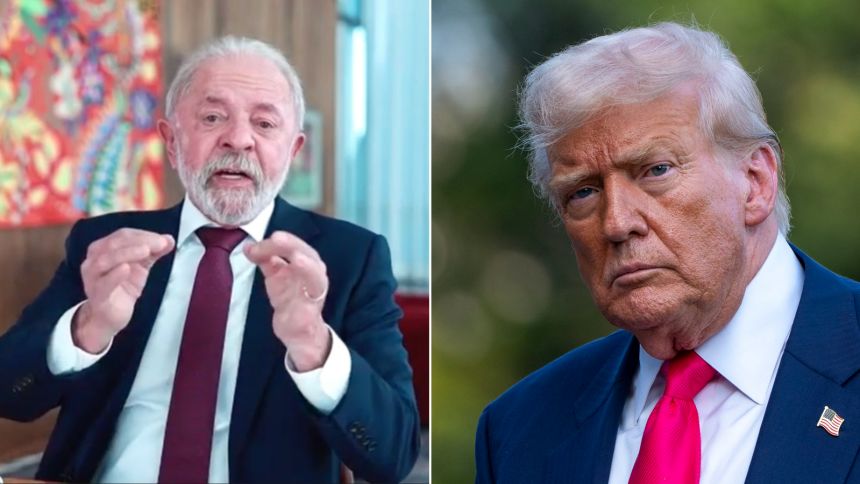

Lula’s Gulf Gambit: Brazilian Socialist Dares Trump to Defend American Waters
By Hotspotnews
In a move dripping with ideological spite and economic delusion, Brazil’s leftist President Luiz Inácio Lula da Silva has thrown down a gauntlet at President Donald Trump’s feet. Speaking in Manaus on May 27, Lula announced plans for a partnership between Brazil’s state-controlled Petrobras and Mexico’s notoriously inefficient Pemex to explore for oil in the Gulf of Mexico. His taunting challenge? To “see if our comrade Trump will get involved.”
This isn’t mere diplomacy—it’s classic socialist provocation, the kind that reveals the deep resentment many global leftists harbor toward a resurgent, America First United States. Lula, a lifelong admirer of failed Marxist experiments from Havana to Caracas, couldn’t resist injecting “companheiro” (comrade) into his remarks about the U.S. president. The message was unmistakable: Let’s poke the bear in waters Trump has boldly reclaimed as the Gulf of America.
For months, Trump has made clear his commitment to American energy dominance and national sovereignty. His executive order renaming the Gulf underscores a simple truth: these are vital strategic waters for the United States, home to enormous energy reserves that power our economy and strengthen our security. Under Trump, America is once again unleashing its domestic oil and gas production, slashing dependence on foreign regimes, and prioritizing U.S. workers over international bureaucracies.
Lula’s proposal, by contrast, reeks of the same state-heavy socialism that has turned Petrobras into a patronage machine plagued by corruption scandals and turned Pemex into a cautionary tale of inefficiency. Mexico’s state oil company has struggled for years under layers of bureaucracy, subsidies, and political meddling. Partnering with it won’t bring cutting-edge innovation—it will likely export Brazil’s own history of scandals and mismanagement into contested waters.
The timing is no coincidence. Lula’s remarks follow Trump’s firm stance on border security, trade fairness, and rejecting the climate alarmism that weakens Western economies. By floating this joint venture in deep waters—some 2,500 meters down—Lula appears to be testing whether a strong American leader will tolerate foreign state actors encroaching on America’s economic backyard. It’s the geopolitical equivalent of thumbing your nose while hoping the sheriff looks the other way.
Conservatives have long warned about the “pink tide” in Latin America: a resurgence of populist leftists who centralize power, demonize private enterprise, and cozy up to adversaries of the United States. Lula’s Brazil has embraced this path, defending regimes in Venezuela and Cuba while lecturing the West on “democracy.” His flirtation with BRICS expansion and anti-American rhetoric fits a pattern of undermining U.S. influence in the hemisphere.
President Trump, however, has never backed down from such challenges. His first term proved that clear-eyed realism—peace through strength—delivers results. Energy independence wasn’t just a slogan; it reshaped global markets and weakened petro-dictators. A second Trump term promises to double down on that vision: securing our borders, revitalizing manufacturing, and ensuring that critical resources near our shores serve American interests first.
Lula’s dare exposes the left’s fundamental misunderstanding of power. While socialists dream of supranational alliances and wealth redistribution, conservatives understand that strong nations protect their sovereignty and their people. The Gulf of America is not a playground for Brazilian-Mexican experiments in state capitalism. It is a strategic asset for the United States, one that should benefit American companies, American workers, and American consumers—not subsidize failing foreign bureaucracies.
Brazil itself sits on vast untapped reserves in its own pre-salt fields and Equatorial Margin. If Lula truly cared about his country’s prosperity, he would focus on reforming Petrobras for efficiency, cutting red tape, and inviting private investment rather than chasing headlines by antagonizing Washington. Instead, he opts for performative defiance, the sort that plays well with his domestic base but risks isolating Brazil from the engine of hemispheric growth: the United States.
As Trump returns to the White House, expect no tolerance for such antics. America will prioritize its energy security, its alliances with responsible partners, and its right to lead in its own region. Lula’s provocation may generate chuckles in leftist salons, but it changes nothing about the new reality: sovereignty matters, strength deters, and America is back.
The Gulf belongs to those who will develop it responsibly and in the interest of their own citizens—not as a stage for outdated ideological theater. Trump knows this. The question now is whether Lula is prepared for the consequences of forgetting it.