

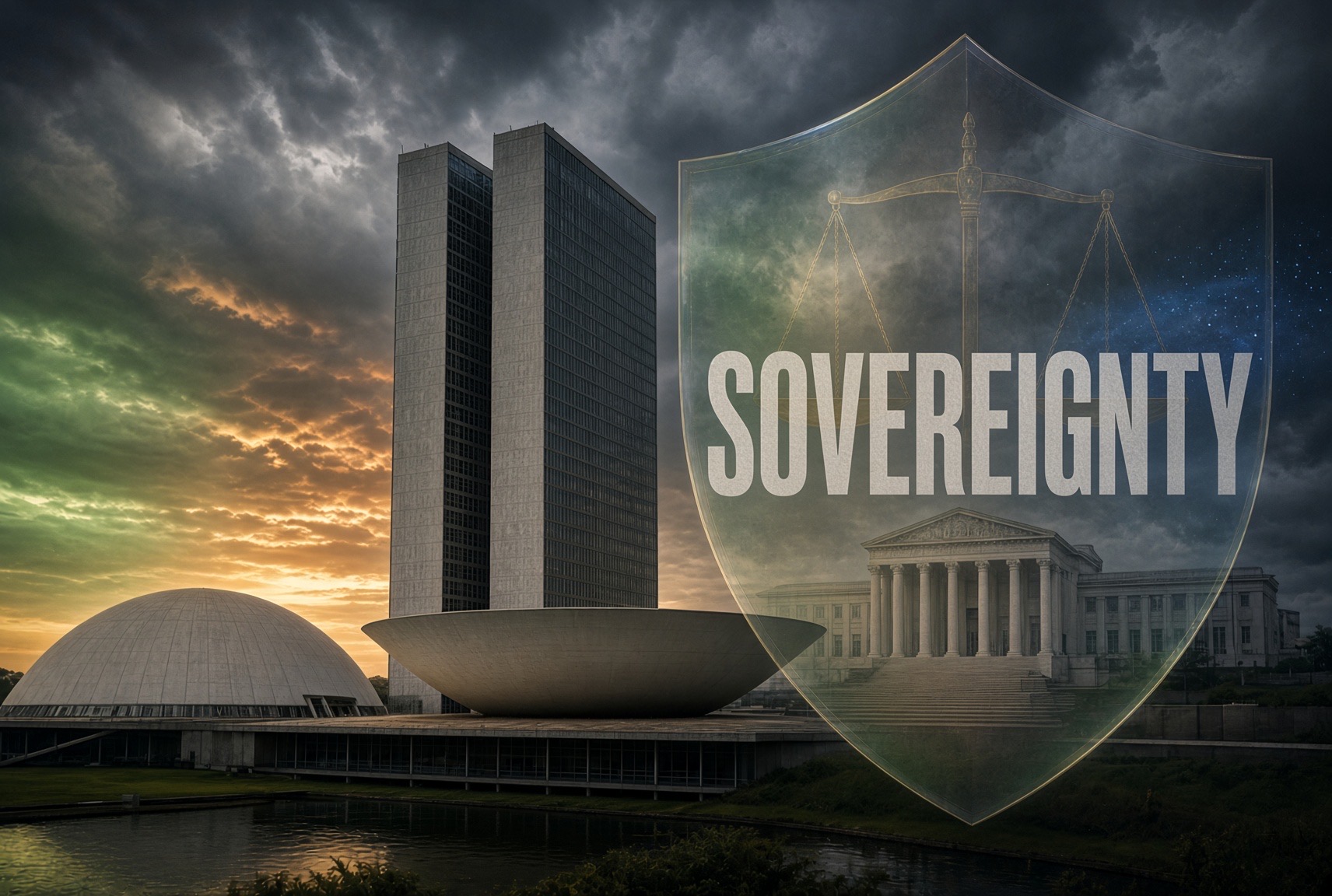

The Abuse and Misuse of the Term Sovereignty in Brazil
By Hotspotnews
Sovereignty in Brazil has long served as both a constitutional principle and a political rallying cry. The 1988 Constitution lists national sovereignty among the foundations of the Republic, and the concept has structured debates over independence from Portugal, the transition from empire to republic, the Vargas era’s economic nationalism, the military period’s security doctrine, and the post-1985 democratic order. At its core it still denotes the state’s ultimate authority over its territory, population, and external relations. In practice, however, the term is frequently detached from that core and redeployed to advance selective claims.
One recurring pattern treats sovereignty as an absolute barrier to any external constraint or scrutiny. This appears most visibly in discussions of the Amazon. Successive governments have invoked sovereignty to reject foreign monitoring, funding conditions, or public criticism of deforestation rates, land-use policies, and enforcement capacity. The claim is not without historical grounding: external powers have at times treated the region as a global commons open to unilateral pressure. Yet the absolute version of the argument often ignores that Brazil itself has ratified climate, biodiversity, and indigenous-rights instruments, accepted satellite monitoring cooperation, and sought international climate finance. When “sovereignty” is redefined to mean the right to accept resources and markets while rejecting associated reporting or standards, it functions less as a description of final authority and more as a veto against inconvenient obligations. Parallel uses appear in resistance to certain trade or investment rules and, during the COVID-19 period, in selective rejection of World Health Organization guidance while still participating in global vaccine procurement.
A second distortion runs in the opposite direction. Domestic and foreign actors sometimes portray Brazilian sovereignty as an outdated obstacle whenever it conflicts with preferred environmental, indigenous, or human-rights outcomes. Proposals for external oversight mechanisms, conditional aid that effectively rewrites land-use rules, or international judicialization of Amazon policy treat the Brazilian state’s territorial authority as presumptively illegitimate. Indigenous land demarcations raise a related tension: constitutional recognition of indigenous territorial rights is a domestic legal arrangement, yet some advocacy frames any federal limitation or economic use of those areas as a violation of a higher sovereignty. The practical problem remains that only the Brazilian state possesses the police power, tax authority, and diplomatic standing required to enforce or revise those arrangements. Relocating final decision-making to external forums or non-state actors does not eliminate the need for an accountable locus of authority; it merely obscures it.
A third, narrower misuse appears in fringe legal theories that attempt to import “sovereign citizen” style arguments into Brazilian administrative or tax disputes. These remain marginal and have been consistently rejected by Brazilian courts, which treat statutory and constitutional jurisdiction as binding. Their occasional circulation nevertheless illustrates how the prestige of the term can be borrowed for private evasion rather than public authority.
Across these uses, asymmetry is common. Governments assert sovereignty against foreign environmental criticism while actively courting foreign capital for infrastructure, agribusiness, and energy projects, including in the Amazon. They defend non-interference in domestic affairs yet participate in regional bodies such as Mercosur and in BRICS coordination that constrain policy autonomy in other domains. Opposition forces and civil-society groups may celebrate external pressure when it aligns with their preferences and denounce it as imperial when it does not. The military and security establishments have historically linked sovereignty to border control and internal order, while economic nationalists have linked it to resource control (oil, minerals, hydroelectric potential); each camp tends to de-emphasize the term when its own priorities require international cooperation.
The consequences for Brazilian politics are concrete. Debates over the Amazon, indigenous territories, trade agreements, and foreign investment become harder to resolve when every concession is labeled a surrender of sovereignty and every assertion of domestic priority is labeled obstruction or denial. Durable policy requires explicit bargains—about monitoring, benefit-sharing, enforcement capacity, and the division between federal, state, and indigenous authority—rather than rhetorical escalation. Brazil’s size, resources, and federal structure already impose practical limits on any pure conception of sovereignty; those limits are not erased by repeated invocation of the word.
Precision would not settle the underlying conflicts over development models, environmental enforcement, or the balance between integration and autonomy. It would, however, restore a shared reference point: the identification of which entity can make and enforce final decisions for the Brazilian population, and under what conditions that entity may pool or limit discrete powers. When the term is used mainly as a flexible instrument of political convenience, that identification is lost.