

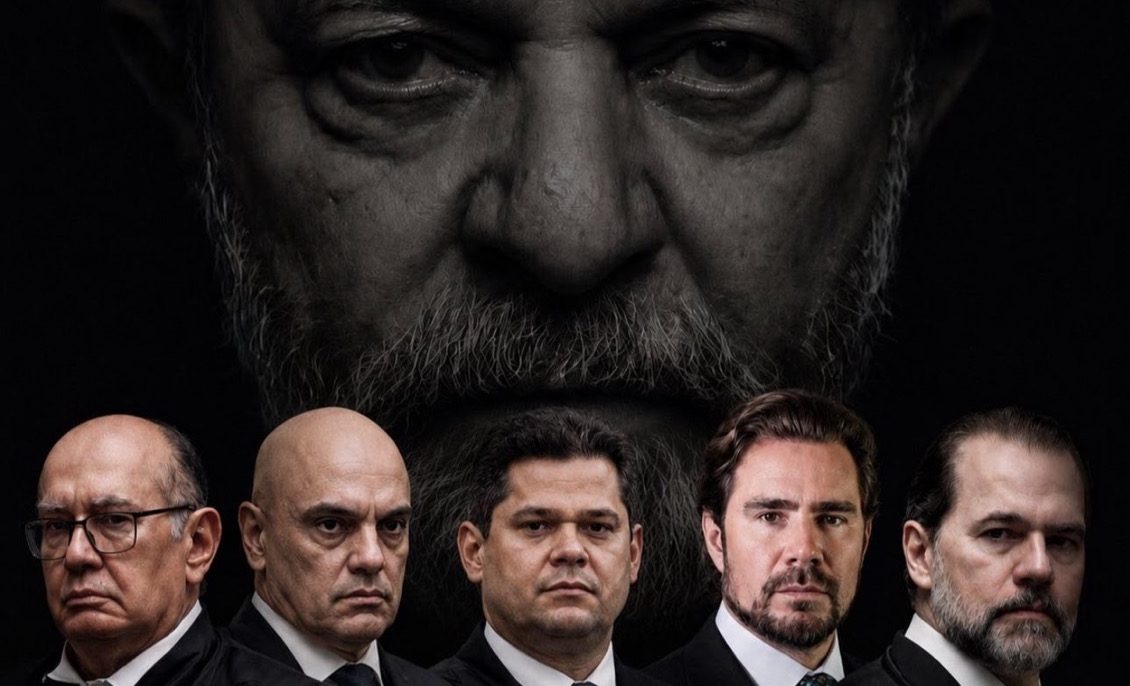

The STF’s Self-Dealing Cabal: How Moraes, Toffoli, and Gilmar Mendes Run Brazil’s Highest Court for Themselves And Nobody dares to stop them!
By Hotspotnews
In a country where ordinary citizens face the full force of the law for far less, three of the most powerful men in Brazil’s Supreme Federal Court—Alexandre de Moraes, Dias Toffoli, and Gilmar Mendes—have turned the nation’s highest judicial body into a private fortress protecting their own interests and those of their allies. The Banco Master scandal has ripped the veil off this reality. What journalist Malu Gaspar and others have documented is not coincidence or routine advocacy. It is systematic self-dealing at the apex of Brazilian power.
The facts are damning and public.
Daniel Vorcaro’s Banco Master collapsed under the weight of massive fraud, leaving a hole estimated in the billions. The Central Bank liquidated it. The Federal Police launched Operation Compliance Zero. Vorcaro and associates faced arrest. Yet as the investigation advanced, the Supreme Court intervened in ways that consistently shielded the banker’s orbit—and, more importantly, the ministers themselves.
Start with Alexandre de Moraes. His wife’s law firm, Barci de Moraes Advogados (where their children also work), signed a contract with Banco Master worth R$129 million over three years—R$3.6 million per month. The agreement explicitly included defending the bank’s and Vorcaro’s interests before the Central Bank, the Federal Revenue Service, and Congress. Payments reportedly reached tens of millions before the liquidation halted them. Reports further indicated contacts and travel involving planes linked to Vorcaro’s network. When the heat intensified, the institutional response was denial and deflection rather than transparent accounting. A minister whose family firm pockets extraordinary fees from a bank under investigation has no business remaining anywhere near related matters. In any serious democracy, this would trigger immediate recusal and investigation. In Brazil’s STF, it triggers collective silence.
Then there is Dias Toffoli. His family company, Maridt Participações, held stakes in the Tayayá luxury resort. That stake was sold to a fund (Arleen) controlled by Reag Investimentos and linked to Fabiano Zettel, Vorcaro’s brother-in-law. Police recovered messages and evidence of multiple meetings between Toffoli and Vorcaro. Toffoli flew on aircraft connected to the businessman’s circle. As the initial rapporteur of the Master case, Toffoli pulled the investigation into the STF, imposed extreme secrecy, ordered seized cell phones locked away from Federal Police analysis, and staged unusual confrontations. Only after a detailed PF report highlighting these connections did he step aside—while the full Court issued a joint note solemnly declaring there was “no suspicion” and validating his prior acts. The appearance of conflict was so blatant that the Court had to stage-manage an exit, yet still refused to admit the obvious.
Gilmar Mendes completed the triangle. The Court’s senior justice repeatedly defended his colleagues, publicly and procedurally. When the Senate’s Organized Crime CPI sought banking, tax, and digital records of Toffoli’s family company Maridt, Mendes annulled the request and ordered the destruction of data already collected. He did so through procedural maneuvers that bypassed normal distribution rules, even though he was not the case rapporteur. Mendes has also worked to tighten the already near-impossible path to impeaching STF justices, concentrating power further inside the institution that polices itself. The pattern is consistent: protect the corporation of the Court above the rule of law.
These are not isolated “family business” stories. They form a clear picture of institutional capture. The same Court that expanded its own powers through monocratic decisions, secret inquiries, and aggressive censorship now faces a scandal that touches its leading figures—and responds with self-protection. The CPI of Organized Crime formally recommended the indictment of Moraes, Toffoli, and Mendes for crimes of responsibility. The Federal Police has accumulated extensive material. Yet meaningful accountability stalls because investigating sitting STF ministers requires the Court’s own authorization. The foxes guard the henhouse by design.
This is the logical endpoint of judicial supremacy without effective checks. Brazil’s Constitution grants the STF enormous power and life tenure with minimal external oversight. Over the past decade that power has been exercised aggressively against political opponents while the internal culture of mutual protection hardened. The Master affair exposes the result: when the interests of powerful ministers and their families collide with a major fraud investigation, the Court prioritizes its own.
Conservatives have long warned that concentrated, unaccountable judicial power corrodes republican institutions. The Master scandal proves the warning correct. Ordinary Brazilians who break the law face prison. Ministers whose families profit from the same orbit, who meet the principals, who travel on related aircraft, and who then control the legal process face carefully worded joint statements and procedural shields.
True institutional integrity demands more. Full, independent investigation of every financial and personal link. Automatic and enforced recusal standards with real teeth. Reform of the impeachment process so that the Senate can hold justices accountable without the Court’s permission. An end to the culture in which the highest court treats itself as above the ordinary rules that bind every other Brazilian.
The video circulating today that states “Moraes, Toffoli and Gilmar Mendes administer the STF in their own interest” does not invent a conspiracy. It names what the documented record already shows. Brazil cannot restore public trust in its institutions while the guardians of the Constitution treat the Court as private property. The rule of law either applies to everyone—including the most powerful justices—or it applies to no one.