

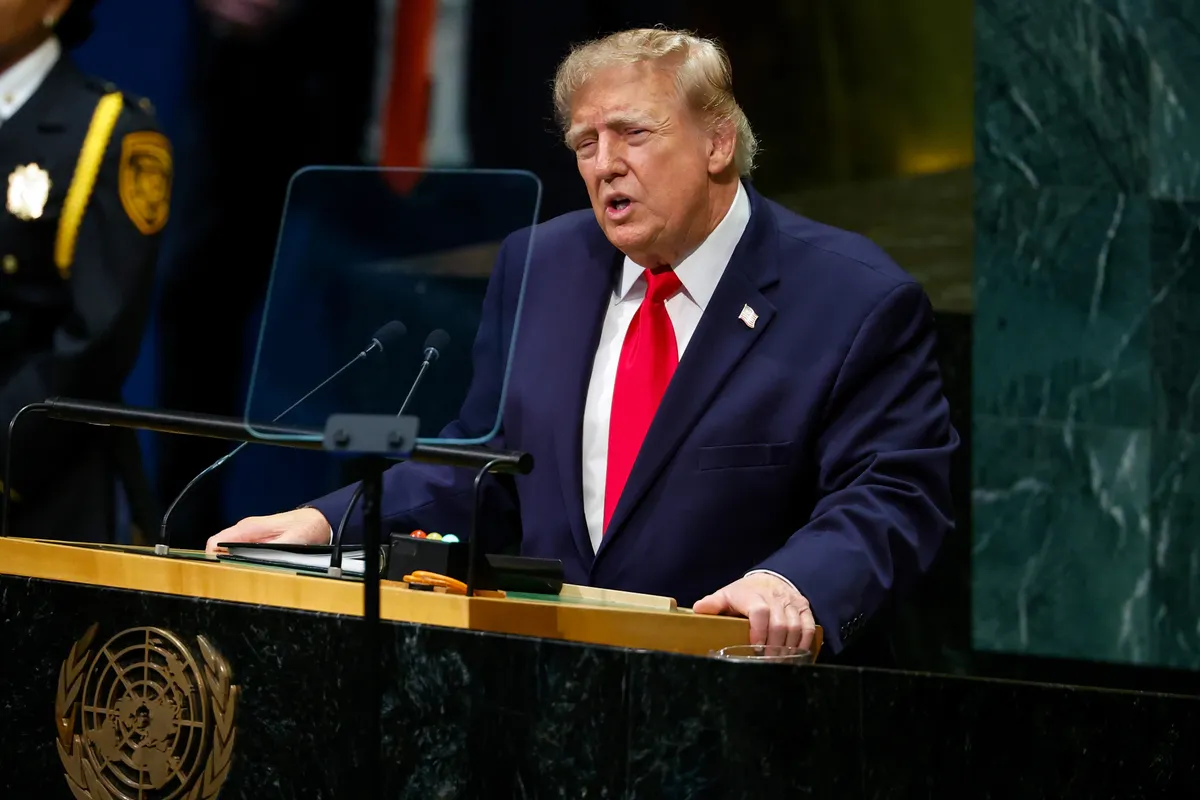

On Tuesday, September 22, 2026, on the sidelines of the U.N. General Assembly in New York, the United States and 14 Latin American and Caribbean governments announced their first joint action under the Shield of the Americas: coordinated measures against 24 organizations they labeled transnational “narcoterrorist” groups. Brazil was not among the signatories. Mexico was not either. Two of the groups on the list, however, are Brazilian: the Primeiro Comando da Capital (PCC) and the Comando Vermelho (CV).53
The announcement followed a direct request from President Donald Trump that coalition members adopt the U.S. classification of the groups as a shared hemispheric threat and apply sanctions. Hours earlier, Brazilian President Luiz Inácio Lula da Silva had told the same U.N. assembly that Brazil would not “outsource” the defense of its borders and did not need “aircraft carriers watching our waters.” The two events, on the same day in the same city, made the split explicit.84
What was announced
The joint declaration, released by the U.S. State Department with the participating governments, states that narcoterrorist organizations “endanger the peace and security of the hemisphere as well as the safety and prosperity of our citizens.” The first collective action, the text says, will focus on 24 listed groups “regardless of the name they receive in each of our countries.”52
The measures the governments say they intend to impose, “as applicable” and in line with each country’s domestic and international legal obligations, are:
- freezing of assets tied to the organizations
- immigration and visa restrictions on members, associates, and supporters
- criminal liability for people who knowingly provide material support, including logistics
The document also records an intent to act both individually and collectively, and to ask the Organization of American States Permanent Council to activate consultation under the 1947 Inter-American Treaty of Reciprocal Assistance, known as the Rio Treaty or TIAR. That step would give the political package a hemispheric legal hook, though it would still depend on national implementation.57
The declaration is not, by itself, a new statute in any of the 15 capitals. Each government still has to apply the measures under its own law. What changed on Tuesday is that a bloc of governments publicly aligned their threat assessment with Washington’s and put Brazilian factions on the same list as Mexican cartels, Central American gangs, Colombian armed groups, and Venezuelan networks.
Who signed — and who did not
The signatories named in the statement are the United States, Argentina, Bolivia, Chile, Colombia, Costa Rica, the Dominican Republic, Ecuador, El Salvador, Guyana, Honduras, Panama, Paraguay, Peru, and Trinidad and Tobago. That is 15 governments in total: the United States plus 14 partners.62
The Shield of the Americas (Escudo das Américas / Escudo de las Américas) was launched by Trump on March 7, 2026, at a summit in Miami. It is described by participants as a coalition built on three pillars: economic cooperation, security cooperation, and multilateral coordination. Membership has grown through 2026 as governments in Colombia, Peru, and Chile joined or formalized participation. Some reporting puts the broader coalition near 19 countries; Tuesday’s sanctions text was signed by the 15 listed above. Guatemala, Jamaica, Belize, and the Bahamas were described in some accounts as Shield-related governments that did not sign this particular statement.74
Brazil and Mexico are the two largest countries in Latin America that stand outside the alliance. Both have governments that reject the U.S. terrorist designation of major criminal organizations operating on their soil. Venezuela, Cuba, Nicaragua, Uruguay, Canada, and several Caribbean states are also outside the group. The coalition therefore includes many of Brazil’s neighbors — Argentina, Bolivia, Paraguay, Peru, Colombia, Guyana — while leaving out the country where PCC and CV were born.
The 24 organizations
The list mixes prison-originated factions, street gangs, Mexican cartels, Colombian armed groups, and networks tied to Venezuela, Haiti, Ecuador, and Peru. Compiled from the Chilean foreign ministry readout and Brazilian and regional reporting, the targets include:59
- Mara Salvatrucha (MS-13)
- Tren de Aragua
- Carteles Unidos
- Cartel del Golfo
- La Nueva Familia Michoacana
- Cartel del Noreste
- Cártel de Jalisco Nueva Generación (CJNG)
- Cartel de Sinaloa
- Gran Grif
- Viv Ansanm
- Los Lobos
- Los Choneros
- Barrio 18
- Cartel de los Soles
- Clan del Golfo
- Primeiro Comando da Capital (PCC)
- Comando Vermelho (CV)
- Chone Killers
- Los Viagras
- Cartel de Juárez (La Línea)
- FARC dissident structures, including Estado Mayor Central and Segunda Marquetalia
- ELN
- Sendero Luminoso
- Los Tiguerones
All 24 had already been sanctioned or designated in some form by Washington. Tuesday’s move was an attempt to multilateralize that list across a bloc of Latin American and Caribbean governments.
Why PCC and CV are on it
PCC and CV are no longer only Brazilian prison factions. Official and prosecutorial estimates circulating in 2025–2026 put PCC at about 40,000 members, with presence in most Brazilian states and connections mapped in roughly 28 countries. CV is estimated at around 30,000 members, with aggressive expansion through the Amazon and alliances along cocaine routes from producer countries. Together they are described as present in all 27 Brazilian federative units and hegemonic in 13 states.
The United States designated both as Specially Designated Global Terrorists and then as Foreign Terrorist Organizations in May–June 2026. The U.S. argument is that the groups use extreme violence, control territory, move cocaine at industrial scale, and have become a threat to regional and U.S. security. A September U.S. report accused Brasília of failing to confront them with sufficient urgency and of allowing Brazil to become a global cocaine-distribution hub.
Brazil’s legal answer is different. Brazilian terrorism law is narrower: it focuses on acts driven by xenophobia or racial, ethnic, or religious prejudice and intended to cause generalized terror. PCC and CV, in the official Brazilian view, are criminal organizations built around profit, trafficking, money laundering, and territorial control. They are to be fought with criminal law, the Anti-Faction Law, integrated operations, and border cooperation — not with a terrorism label that, officials fear, could be used as a pretext for external pressure or force.
That legal distinction is why Brazil can say it is fighting the same groups while refusing the same name. It is also why a coalition of neighbors can put those groups on a joint list without Brazil’s signature.
 Lula’s position, stated the same day
Lula spoke first in the U.N. general debate, as Brazil traditionally does. He said people are tired of violence, that workers are robbed and police do not come home, and that Brazil is prepared to confront the organizations that terrorize communities. He then drew a line:
Brazil would not outsource responsibility for its borders. It did not need foreign warships off its coast. It needed cooperation to cut the flow of weapons and money that feed organized crime. That, he said, was the spirit of a proposal he had personally delivered to Trump: cooperation against money laundering by Brazilian criminals abroad. He also said “Brazil does not fit in anyone’s backyard.”85
The Brazilian government has pointed to the Anti-Faction Law, plans to retake territories dominated by factions, and a proposed public-security constitutional amendment that could create a federal Ministry of Public Security. Critics, including the U.S. government and several Shield members, say those tools have not stopped the groups from spreading across states and borders.
The sovereignty argument is not empty. A foreign terrorist designation can unlock asset freezes, visa bans, and, in U.S. practice, a broader set of national-security authorities. Brazilian officials have said they worry that the label could be stretched into justification for operations that bypass Brasília. The cost of that stance is equally concrete: when neighbors freeze assets, restrict visas, and treat Brazilian factions as a common enemy, Brazil is not at the table that writes the rules.
What the coalition can and cannot do without Brazil
The practical effect of Tuesday’s statement depends on what each signatory actually implements.
Asset freezes and visa bans in the United States, Argentina, Paraguay, Bolivia, Peru, Colombia, and Chile can hit money, travel, and logistics that already cross those borders. PCC’s documented presence in Paraguay and elsewhere, and CV’s Amazon routes linking Brazil to producer countries, mean that action outside Brazil is not symbolic. Criminal liability for material support can also reach facilitators who live or bank in signatory countries.
What the coalition cannot do without Brazil is dismantle the domestic base: the prison systems where the factions recruit, the neighborhoods they tax and govern, or the Brazilian ports and rivers they use. Security in Brazil is still largely a state-level responsibility. Federal coordination has improved on paper; territorial control by factions has not disappeared. An organization with tens of thousands of members and international logistics is not dismantled by a communiqué in New York.
The Rio Treaty request, if pursued, would be politically significant and legally contested. Invoking a 1947 mutual-defense instrument against criminal groups rather than an armed attack by a state is a stretch of the original design. Supporters will call it adaptation to a new kind of threat. Opponents will call it a vehicle for U.S. security policy under a hemispheric seal.
The split the announcement made visible
Tuesday did not create the disagreement. The United States listed PCC and CV in mid-2026. Lula rejected the designation then and rejected it again this month. What Tuesday did was show that a critical mass of governments in the region — including countries that share long borders with Brazil — are no longer waiting for Brasília to accept the U.S. framing.
The coalition’s bet is that treating cartels, gangs, and factions as a single narcoterrorist problem will make financial and immigration tools bite across jurisdictions. Brazil’s bet is that it can fight the same groups as criminals, keep legal and political control of the fight, and still get cooperation on money and guns without accepting a terrorism architecture designed in Washington.
Those two bets now run in parallel. One has 15 governments and a list of 24 organizations. The other has the country where two of those organizations are largest. Until those tracks converge, the hemisphere will sanction Brazilian factions from the outside while Brazil insists the problem remains, first and last, its own.