

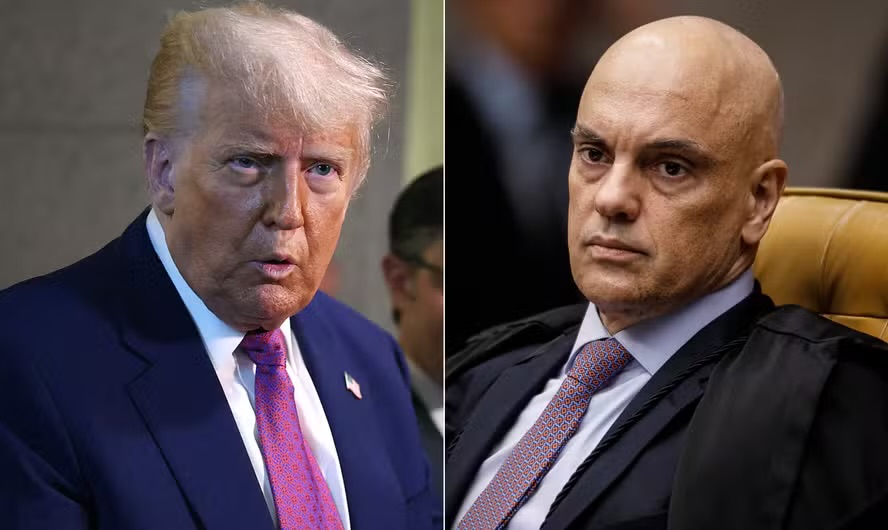

Trump Administration Eyes Action Against Brazil’s Notorious Censor Alexandre de Moraes
By Hotspotnews
In a significant development highlighting the Trump administration’s commitment to defending free speech and holding authoritarian actors accountable worldwide, sources indicate that Washington is closely monitoring a brazen intimidation campaign by Brazilian Supreme Court Justice Alexandre de Moraes against an independent journalist.
The case involves Maranhão journalist Luís Pablo Conceição Almeida, who dared to report on alleged irregularities involving the use of official vehicles by family members of leftist Minister Flávio Dino. In response, Moraes authorized police raids and opened an inquiry accusing the reporter of “persecution” and harassment—classic tactics from a justice who has spent years weaponizing Brazil’s courts to silence dissent, censor social media, and target political opponents of the Lula regime.
This is the same Alexandre de Moraes who has become a symbol of judicial tyranny: suspending accounts of conservative voices, ordering the arrest of critics without due process, and leading what many describe as a systematic crackdown on free expression in Brazil. His actions have drawn international condemnation from those who value liberty over leftist control.
President Trump’s team is reportedly evaluating whether to reimpose Global Magnitsky sanctions against Moraes and his inner circle. These sanctions were previously enacted in 2025 precisely because of Moraes’ documented pattern of human rights abuses—including arbitrary detentions, suppression of political speech, and targeting supporters of former President Jair Bolsonaro. While the sanctions were temporarily lifted late last year amid diplomatic maneuvering, the current review sends a clear message: the era of looking the other way while foreign judges play dictator is over.
Conservatives have long warned that Brazil’s Supreme Court, particularly under Moraes’ influence, has morphed into an unelected super-legislature that threatens democratic norms. From blocking investigations into election irregularities to forcing Big Tech platforms to deplatform Brazilian citizens, Moraes embodies the dangerous fusion of judicial power with ideological enforcement. The harassment of a journalist for simply doing his job is the latest example of this authoritarian drift.
The Trump administration’s willingness to scrutinize this case reflects a broader foreign policy reset: America will no longer tolerate global elites who crush dissent under the guise of “democracy.” By shining a light on Moraes’ overreach, the U.S. is standing with brave journalists and everyday Brazilians who refuse to live under judicial tyranny.
As this story develops, one thing remains certain—under President Trump, the United States will continue to prioritize liberty, accountability, and the defense of fundamental rights against those who seek to extinguish them, whether in Beijing, Tehran, or Brasília. Free nations must push back against censorship, wherever it rears its head.