


Nunes Marques Draws a Necessary Line: The Supreme Court Cannot Become Brazil’s Parallel Electoral Tribunal
By Hotspotnews
On September 28, 2026, TSE President Kassio Nunes Marques sent a formal, firmly worded ofício to STF President Edson Fachin. The document, numbered GAB-SPR/GAB-PRES nº 4307/2026, does what too few senior magistrates have been willing to put in writing: it names the growing pattern of Supreme Court ministers using monocratic decisions and carefully steered petitions to unwind Electoral Court rulings in the middle of an election campaign.
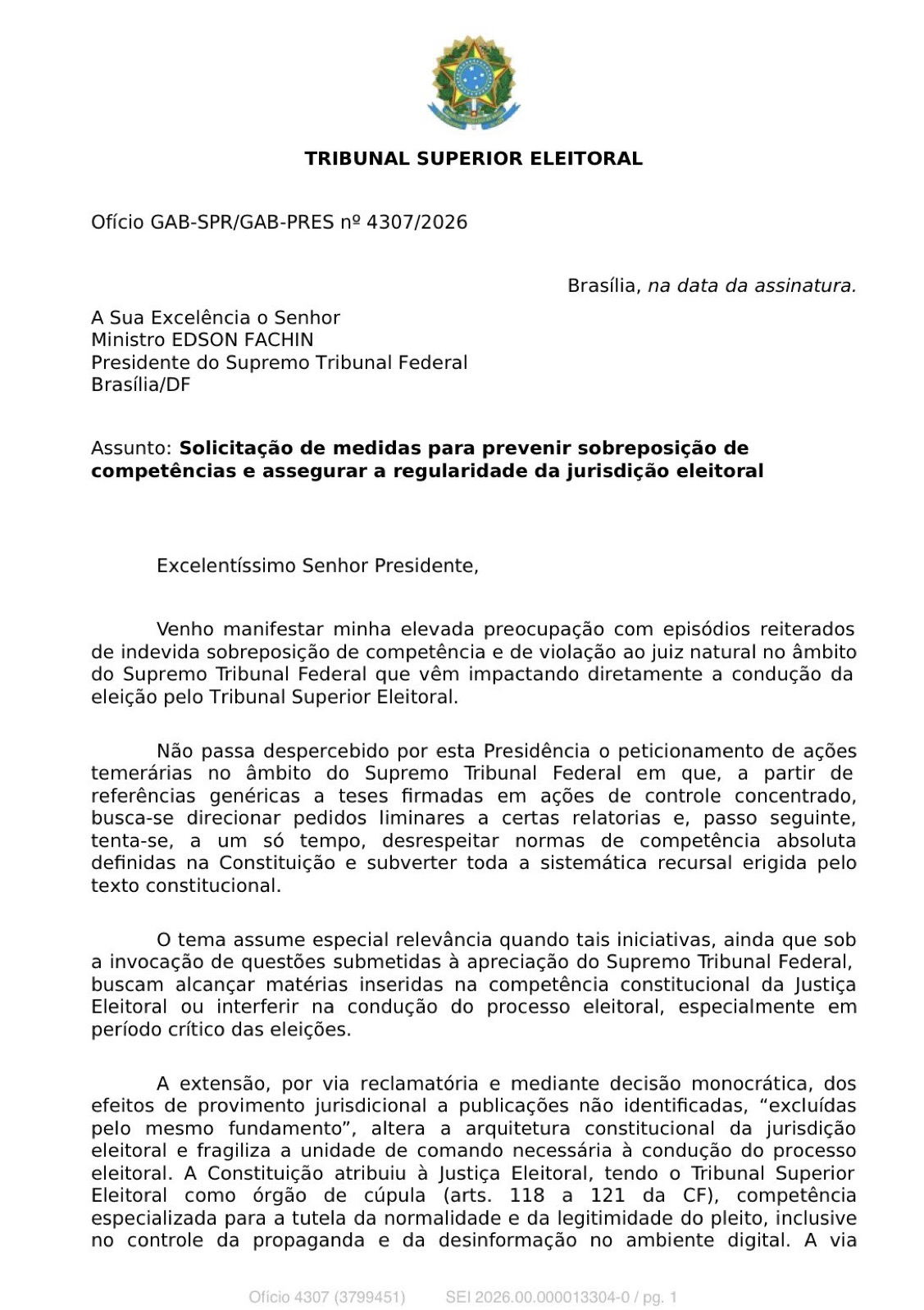
The immediate trigger was a single-minister STF order that restored social-media posts previously restricted by TSE Vice-President André Mendonça. Nunes Marques treated the episode not as an isolated disagreement but as the latest example of a structural problem. Reckless or loosely framed “reclamações” are being filed in existing STF cases so that urgent electoral requests land on preferred desks. The result, he wrote, is an “indevida sobreposição de competência” and a violation of the natural-judge principle that directly affects the TSE’s ability to run the election.
The constitutional design is not ambiguous. Articles 118 to 121 of the Federal Constitution assign specialized competence for the normality and legitimacy of elections—including control of propaganda and digital disinformation—to the Electoral Justice, with the TSE as its apex body. The ordinary path for STF review of TSE decisions is the extraordinary appeal, limited to the hypotheses the Constitution itself lists. When a reclamação is used as a substitute appeal, especially by stretching an open-ended precedent onto concrete electoral acts, that architecture is quietly rewritten.
Nunes Marques warned of “risco de captura institucional”: the functional subordination of the TSE to individual external judgments. Such subordination, he argued, empties both the specialization the Constitution created and the collegiality that gives legitimacy to both courts. The process is formally licit yet materially destructive. Incremental steps of this kind produce democratic erosion by weakening the institutions charged with protecting the integrity of the vote.
He also highlighted a practical danger that conservatives have long flagged in judicial systems: decisions taken in the silence of a single gabinete rather than at the ballot box. If the Supreme Court functions as a parallel electoral instance, the rationale for maintaining a specialized TSE disappears. Campaigns that should be decided by voters risk being decided by isolated ministerial pens, with effects that are hard to reverse in the short electoral calendar. Equality among candidates—isonomia—suffers when one side can shop for a more favorable rapporteur.
The remedy Nunes Marques proposed is modest and institutional: a filter, applied by the STF Presidency itself, on petitions seeking urgent measures related to the 2026 elections, including those filed inside already-pending cases. The goal is to prevent decisions that could distort the playing field. He invoked Fachin’s own earlier language about the risk of “conflitos e sobreposições processuais que configuram grave lesão à ordem pública.” Observing the attributions the Constitution actually wrote, he reminded his colleague, is a duty common to every court.
This is not an attack on judicial review. It is a defense of the division of labor the 1988 Constitution established so that elections remain predictable, specialized, and ultimately accountable to the electorate. When monocratic orders from one court routinely unwind the work of another during the critical period of a campaign, the specialized body loses its reason for existing and public confidence in the process is placed at risk.
Fachin now faces a test of institutional stewardship. The ofício is public, the arguments are grounded in the constitutional text, and the timing—days before a first-round vote—makes delay itself a choice. Whether the STF Presidency will apply the requested filter or allow the current pattern to continue will show whether the Court still regards the TSE as a co-equal specialized organ or merely as a subordinate whose decisions can be rewritten from another building.
Sources: Official TSE Ofício GAB-SPR/GAB-PRES nº 4307/2026 (September 28, 2026); TSE official communication; contemporaneous reporting by G1, O Tempo, CNN Brasil, and VEJA.
#STF #TSE #Eleições2026 #SeparaçãoDePoderes #JuizNatural #NunesMarques #ConstituiçãoFederal #JustiçaEleitoral