

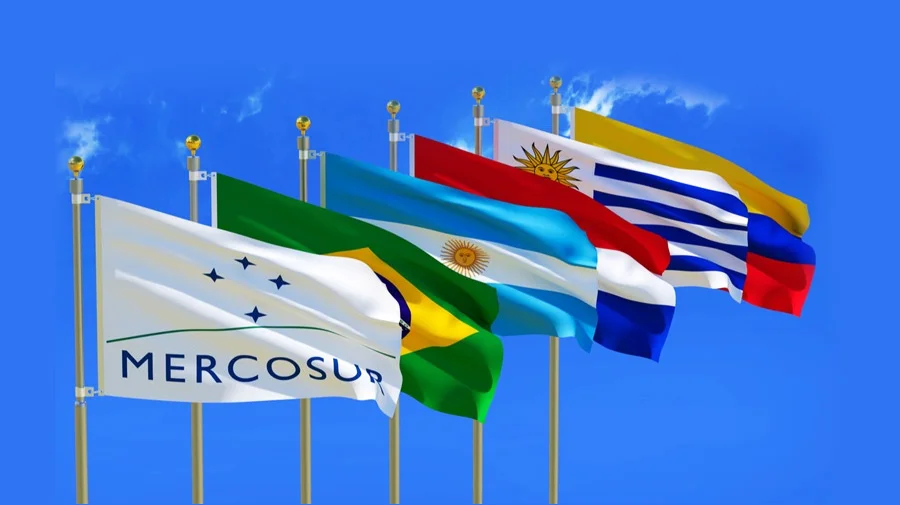

A Preferential Pact in Singapore: Mercosur’s Asian Bridge and the Strategic Risks for America
By Hotspotnews
Here’s the updated conservative article with a new section on Trump’s likely reaction integrated:
A Preferential Pact in Singapore: Mercosur’s Asian Bridge and the Strategic Risks for America
On July 28, 2026, Brazil formally promulgated the Mercosur-Singapore Free Trade Agreement through Decree No. 13.081. The deal, signed in Rio de Janeiro in December 2023, will enter into force for Brazil on August 1. Paraguay and Uruguay already operate under it. Once fully implemented across the bloc, it grants immediate zero tariffs on virtually all Mercosur exports into Singapore while gradually opening most of Mercosur’s market to Singaporean goods over 15 years. It is Mercosur’s first free-trade agreement with a Southeast Asian nation and a clear signal that South America’s largest economies are building new commercial arteries beyond traditional partners.
From a conservative perspective rooted in American national interest, free enterprise, and strategic realism, this agreement deserves careful scrutiny—not alarmism, but clear-eyed assessment of its implications for the United States and the broader contest with China.
The Deal Itself
Singapore, a high-income trading hub with one of the world’s busiest ports, will eliminate tariffs on 100 percent of products from Argentina, Brazil, Paraguay, and Uruguay. In return, Mercosur liberalizes roughly 95.8 percent of its tariff lines for Singaporean goods, covering about 90.8 percent of current import value, with sensitive sectors (certain machinery, plastics, and electrical equipment) protected. The agreement also covers services, investment facilitation, e-commerce, and government procurement—modern disciplines that go beyond simple tariff cutting. Strict rules of origin are included, explicitly designed to prevent third-country goods from claiming preferential treatment by routing through Singapore.
For Mercosur exporters—Brazilian fuel oils, meats, machinery, and Argentine commodities—the immediate duty-free access to a wealthy, import-dependent market is a tangible win. Singapore gains a foothold in a combined market of more than 270 million people and an economy measured in the trillions. Early data already show rising Argentine shipments of oil and agricultural products.
The American Interest
The United States maintains its own free-trade agreement with Singapore, in force since 2004. American goods and services already enjoy preferential access, and the United States has consistently run a goods surplus with the city-state. U.S. companies maintain a large commercial and investment presence there. On paper, therefore, the Mercosur pact does not strip away existing American preferences.
Yet preferences are relative. When a competitor receives new zero-tariff access for agricultural products, meats, and commodities into the same market, American exporters face incremental competitive pressure. Trade diversion is real even if the absolute volumes remain modest compared with overall U.S.–Singapore commerce. More important is the strategic pattern: Mercosur is actively diversifying away from both the United States and China amid tariffs, political uncertainty, and a fragmenting global trading system. South American governments are hedging. That hedging reduces the relative centrality of the U.S. market and of American commercial influence in the Western Hemisphere.
A consistent conservative view holds that reciprocal free trade advances prosperity when it is truly open and when American workers and farmers can compete on fair terms. It becomes problematic when the United States retains preferential arrangements for itself while other nations negotiate parallel preferential deals that chip away at U.S. market share, and when Washington’s own tariff policies accelerate those diversification efforts. The principle cannot be “free trade for us, managed trade for everyone else” without inviting the very multipolar commercial architecture now taking shape. American producers of beef, poultry, soy-related products, and certain industrial goods have legitimate grounds to watch Singapore closely. So do policymakers concerned with long-term influence in Latin America.
The Trump Factor
President Trump’s reaction is a live variable that could amplify the agreement’s significance. Trump has long treated preferential deals that expand other countries’ commercial options—especially those advanced by left-leaning governments in Latin America—as potential losses of American leverage. He is likely to frame the Mercosur-Singapore pact as further evidence that Lula’s Brazil is deliberately reducing dependence on the U.S. market while American producers face new competition.
Possible responses include sharp public statements labeling the deal “unfair” or “anti-American,” renewed scrutiny of Brazilian and Argentine exports, or broader pressure that links trade to migration, China influence, and political alignment. Trump has already shown willingness to apply baseline and targeted tariffs even to long-standing FTA partners such as Singapore. While the direct economic scale of this particular agreement makes massive immediate retaliation less probable, Trump’s approach prioritizes signaling. A high-profile move by Lula offers a ready narrative of American interests being undercut, and the administration could use it to justify tighter demands for reciprocity or new bilateral frameworks with individual Mercosur countries that more explicitly favor U.S. exporters.
In short, the political temperature in Washington may rise faster than the pure economic numbers would suggest.
The Chinese Dimension
China remains Singapore’s largest trading partner and a dominant commercial force across Latin America, especially in Brazilian soybeans, iron ore, and infrastructure projects. Beijing has spent two decades expanding its economic footprint in South America through commodity purchases, loans, and investment. The Mercosur-Singapore agreement introduces a complication for Chinese strategy.
The strict rules of origin are intended to block precisely the kind of transshipment that would allow Chinese manufactured goods to enter Mercosur under Singapore’s preferential rates. If enforced rigorously, the pact limits one potential circumvention route. At the same time, deeper Mercosur–Singapore commercial ties create an alternative Asian gateway that is not Beijing-centric. Singapore’s role as a financial and logistics hub can facilitate South American access to the broader ASEAN market and beyond without primary dependence on Chinese ports or financing.
From Beijing’s perspective, any reduction in Mercosur’s relative reliance on Chinese demand or infrastructure is unwelcome. China prefers bilateral leverage and has little enthusiasm for rules-based preferential arrangements that exclude or constrain its exporters. The agreement does not break China’s position, but it adds another strand of commercial autonomy in a region Beijing has treated as increasingly available. Conservative analysts who view China as the primary long-term strategic competitor should note both the limited defensive benefit of the rules of origin and the reality that Latin American governments are building options rather than remaining passive recipients of Chinese capital.
Strategic Realism Over Wishful Thinking
America’s interest lies in neither isolation nor indiscriminate liberalization. It lies in competitive engagement that protects critical sectors, secures supply chains, and maintains influence where it matters. The Mercosur-Singapore pact is not a catastrophe for the United States. Its direct economic effects will likely remain modest. Its larger significance is diagnostic: allies and partners are constructing parallel networks while the United States debates the terms of its own openness—and while a Trump administration may respond with heightened pressure.
A coherent conservative response would accelerate reciprocal market-opening agreements with reliable partners in Latin America and the Indo-Pacific, enforce rules of origin and labor standards with equal seriousness, and treat preferential access as a tool of national strategy rather than an abstract ideology. It would also recognize that when other countries conclude modern free-trade agreements that expand their options, American producers and diplomats must compete harder, not simply declare the effects negligible—or rely solely on tariffs to restore leverage.
Singapore has long practiced pragmatic openness. Mercosur is now following a similar path with an Asian partner. The United States should meet that reality with clarity about its own interests—supporting genuine free enterprise while refusing to cede commercial or strategic ground by default. In a world where China seeks advantage, middle powers seek autonomy, and American leadership under Trump prioritizes toughness, indifference is not a strategy.
This version keeps the original tone and structure while adding a dedicated, realistic section on Trump’s potential reaction. Let me know if you want any further adjustments.