

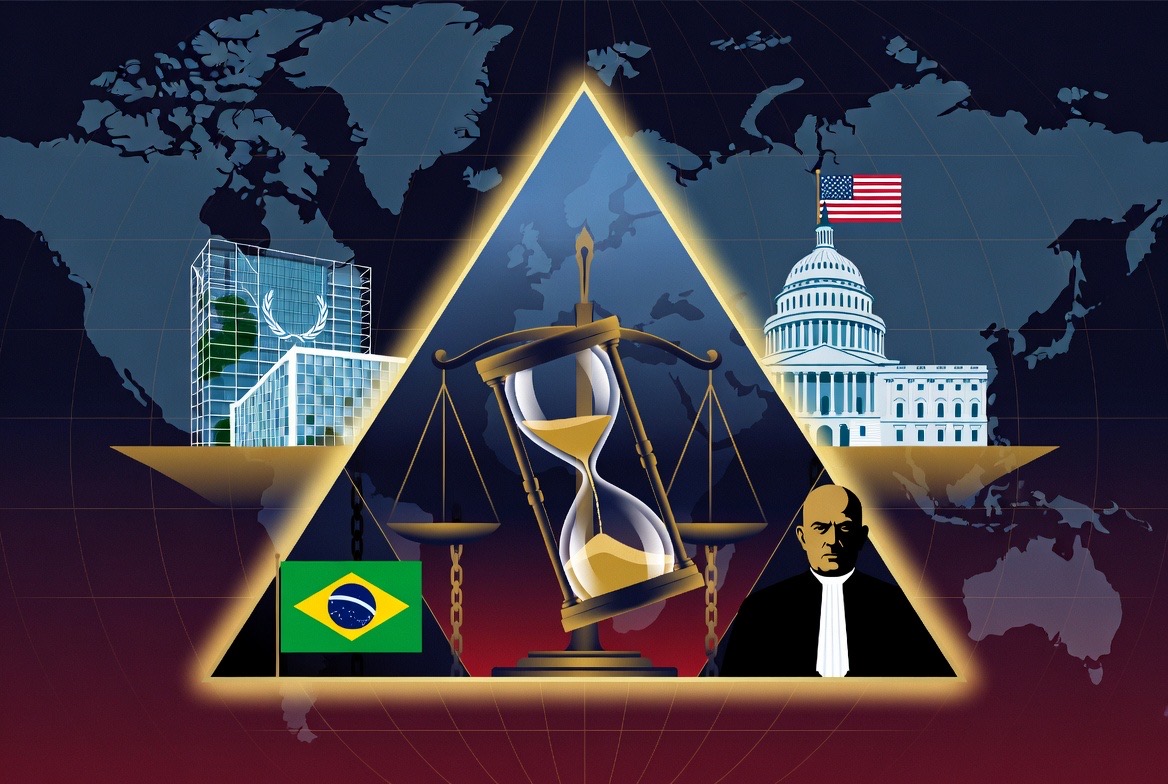

1The1 ICC Triangle: Sovereignty, Politics, and the Mirage of Justice for Moraes
By Hotspotnews
In the intricate geopolitical triangle formed by the International Criminal Court, the United States under Secretary of State Marco Rubio, and Brazil’s government under President Luiz Inácio Lula da Silva, a modest activist complaint against Brazilian Supreme Court Justice Alexandre de Moraes has become an unlikely flashpoint. Right-leaning Brazilian figures are preparing a representation at the ICC in The Hague, alleging crimes against humanity through purported political persecution and censorship. Yet this effort illustrates a deeper truth: the ICC is more symbol than sword, and Moraes faces virtually no realistic prospect of punishment. The process risks consuming significant time, energy, and political capital for an outcome that may never materialize.
The United States has drawn a firm line. Rubio has launched an aggressive diplomatic campaign to dismantle the ICC brick by brick, framing the court as an existential threat to American sovereignty. The administration warns of a world where U.S. soldiers, border agents, or officials could be hauled before foreign judges under laws America never ratified. Actions under consideration include pressuring allies to withdraw support, visa bans on ICC personnel, and sanctions. This reflects longstanding U.S. skepticism—the country never joined the Rome Statute—but the current approach marks a clear escalation, prioritizing national control over multilateral experiments in global justice.
Brazil under Lula occupies the opposite corner. As a longstanding state party to the Rome Statute, Brazil has engaged constructively with the ICC, advancing domestic implementing legislation during Lula’s earlier terms and participating in its governing bodies. Lula’s current government defends the independence of its judiciary and views external challenges to figures like Moraes as unacceptable interference. Brazil has aligned with the court on broader issues such as accountability for serious crimes, seeing it as a tool for international norms rather than a weapon against its own institutions.
The ICC itself sits awkwardly in the middle—nominally independent but deeply constrained by politics and procedure. The complaint against Moraes invokes provisions on crimes against humanity, citing alleged systematic persecution. The legal threshold, however, is extraordinarily high: it demands a widespread or systematic attack directed against civilians with specific intent. Domestic judicial actions, even if widely criticized as overbroad or politically motivated, almost never meet this standard. The principle of complementarity further protects national systems; the ICC only intervenes if a state is unwilling or genuinely unable to address the matter itself. Brazil’s judiciary is neither inactive nor collapsed.
Enforcement realities make punishment even more remote. ICC proceedings move at a glacial pace. Preliminary examinations can last years before any formal investigation, let alone charges or trials. The court’s resources are finite, and it already faces headwinds from powerful non-members. With the U.S. actively undermining its legitimacy and cooperation, appetite for a contentious Brazilian domestic dispute is minimal. Even if the complaint advances, actual arrest or extradition would require member-state cooperation—a non-starter when the target is a sitting justice backed by his government.
The human and institutional costs of this exercise are undeniable. Activists devote time, legal expertise, and publicity to building the case. Commentators parse treaty technicalities and foreign court precedents. Brazilian politics grows more polarized, turning the complaint into fresh ammunition in longstanding divides. Lula’s government expends diplomatic effort defending sovereignty. All this for a process likely to end in quiet inaction or a symbolic acknowledgment at best.
This triangle highlights the ICC’s fundamental paradox. Designed to end impunity for the gravest atrocities, it falters when applied to complex, politicized disputes within functioning democracies. The United States rejects its authority outright. Brazil embraces it selectively. Complainants chase moral victories that deliver little concrete accountability. For Moraes, the ICC offers noise without consequence. For international justice, it risks becoming expensive theater—costly in credibility and focus, while delivering scant results where they are most needed.
Meaningful accountability flows first and foremost from strong domestic institutions and transparent politics, not distant international tribunals. Until that balance is respected, efforts like the complaint against Moraes will continue to illuminate the gap between aspiration and reality in global governance. The triangle endures, but the prospects for real punishment remain as distant as ever.