



Mendonça Draws a Line: Restraint, Ethics, and the Limits of Judicial Activism
By Hotspotnews
Brazil’s Supreme Court once again exposed its internal fractures this week when Justice André Mendonça issued a formal note responding to public criticism from Justice Gilmar Mendes. The exchange, centered on the Banco Master investigation, is not merely a personal spat. It is a clash between two visions of the judiciary: one that treats the court as a political stage and another that insists on legal limits, institutional decorum, and equal application of rules.
Mendonça’s cabinet began with the statute itself. Article 36, item III of Complementary Law 35/1979, the Organic Law of the National Magistrature, forbids a judge from publicly commenting on a pending case or issuing depreciative judgments about other judicial decisions. Mendes chose to ignore that prohibition and take the dispute to social media. Mendonça answered in writing, through official channels.
The core factual point is straightforward. “The pretension of lifting secrecy of every and any procedure, without exception, did not come from the rapporteur,” the note states. “It came from those who today claim to be indignant with the publicity of the records.” Mendonça lifted secrecy only on a specific proceeding, in a reasoned decision within the limits of his authority. The broader demand for total transparency originated with the same critic now complaining about exposure.
That inconsistency is not incidental. Mendes has long advocated unrestricted publicity of investigations. When the same principle began to affect conversations that embarrassed figures aligned with a different judicial faction, the outrage appeared. Mendonça noted the timing: the sudden concern for “exposure of others” emerged only after access was granted to a suspect’s cellphone and after press leaks that, coincidentally, targeted ministers who held dissenting views.
The note also rejects any suggestion of complicity with leaks. Mendonça ordered investigations into every improper disclosure during the inquiry, including a specific phase examining possible involvement by a Federal Police official. There was no wink at selective leaking. There was an official demand for accountability.
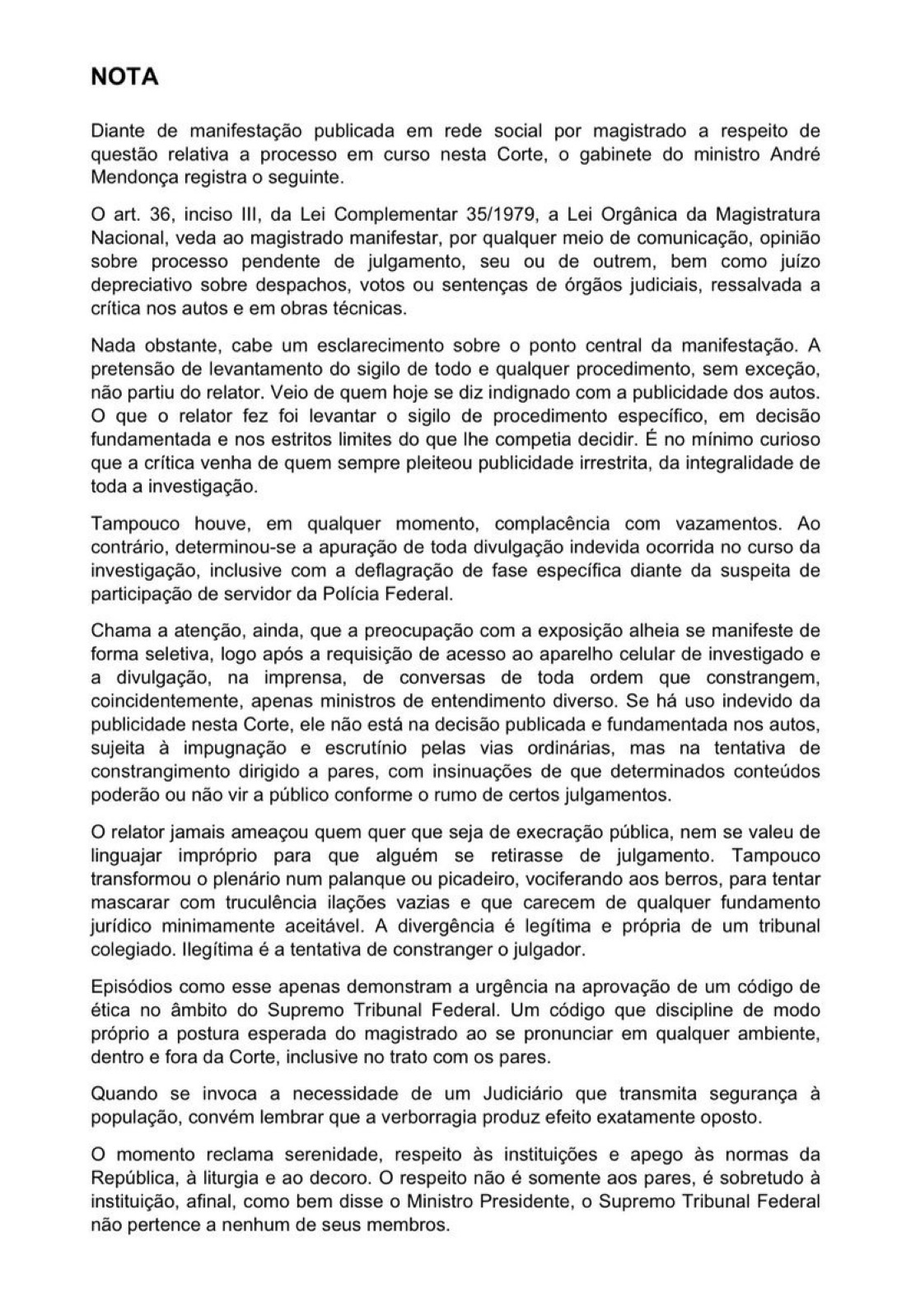
Mendonça further rejected the accusation that he used the court as a political platform. “The rapporteur never threatened anyone with public execration, nor used improper language to force anyone to withdraw from a judgment. He did not turn the plenary into a soapbox or circus, shouting to mask legally baseless insinuations.” Divergence among justices is legitimate in a collegial court. What is illegitimate is the attempt to constrain the judge through public pressure and insinuation.
The deeper institutional warning is the call for an ethics code. Episodes like this, the note argues, demonstrate the urgency of rules that govern how justices speak both inside and outside the court, including in dealings with their peers. Verbosity, Mendonça observed, does not produce public confidence. It produces the opposite.
The closing line is the most important. The Supreme Federal Court does not belong to any of its members. Respect is owed first to the institution, the Republic’s norms, and the liturgy of the office. When those standards are treated as optional, the court ceases to function as a court and begins to function as a factional arena.
Source: Official note issued by the cabinet of Justice André Mendonça on September 17, 2026, in response to public comments by Justice Gilmar Mendes concerning the Banco Master investigation. Legal reference: Complementary Law 35/1979 (LOMAN), Article 36, III.
#STF #AndréMendonça #ÉticaJudicial #EstadoDeDireito #GilmarMendes #JustiçaComLimites #DecoroInstitucional