

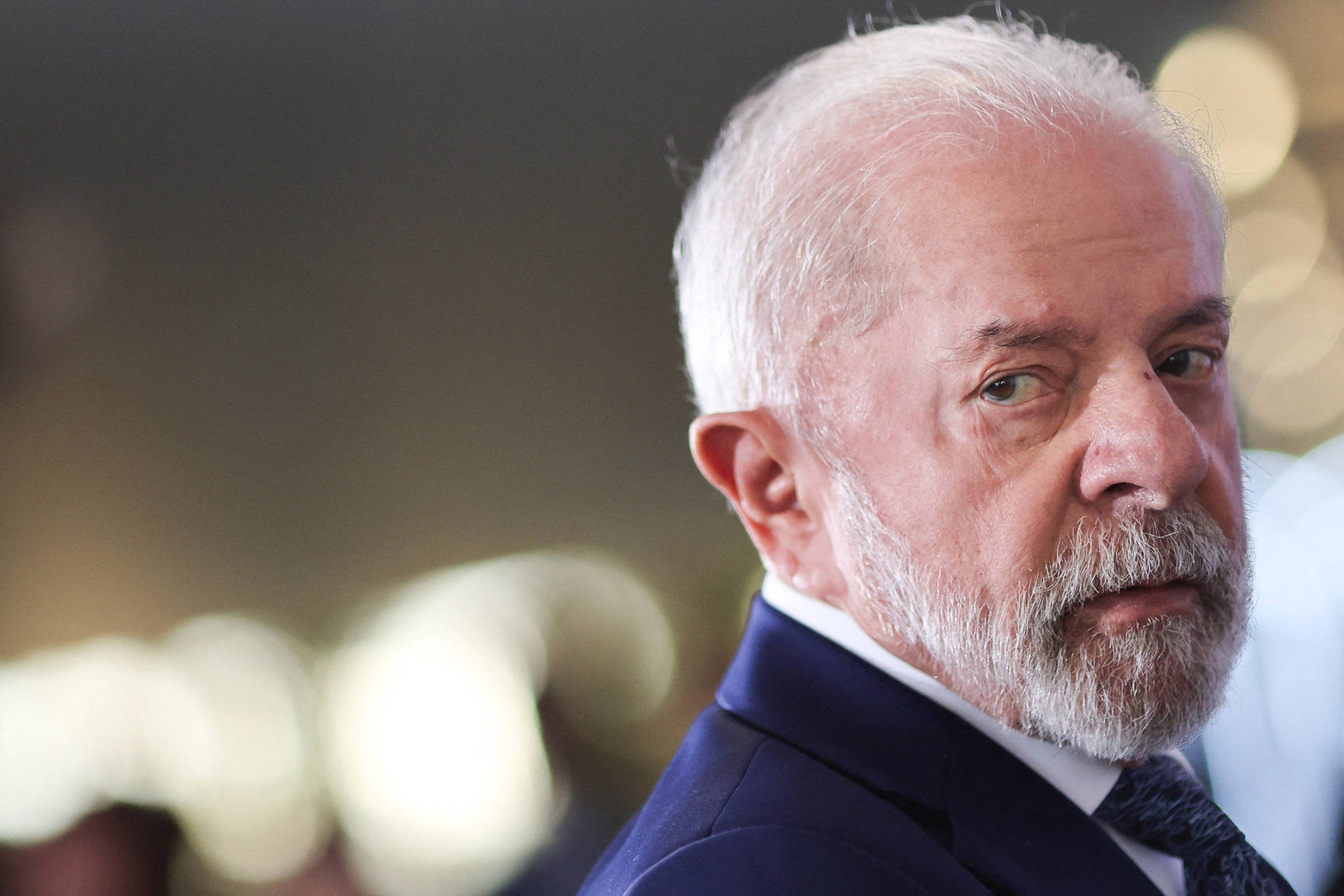

This Is the Mother of All Bombs Against Lula
By Hotspotnews
In what many are calling the political equivalent of the “Mother of All Bombs,” a devastating scandal has exploded right in the middle of President Luiz Inácio Lula da Silva’s international trip to the G7 summit. While Lula stands on the global stage preaching multilateralism, criticizing protectionism, and positioning himself as a champion of the Global South, a highly incriminating dossier has landed directly in the hands of U.S. President Donald Trump. It exposes how Brazilian refineries with close government ties sold over 100 million liters of naphtha—a critical industrial solvent—to a company deeply entangled in fraud schemes that benefit the Primeiro Comando da Capital (PCC), Brazil’s most powerful criminal organization, recently designated a terrorist group by the United States.
The graphic from Diário360 captures the explosive nature perfectly: a stern image of Trump with the bold headline declaring that an incriminating document has reached his hands, revealing how Lula government-linked refineries are supplying criminal factions. The details, backed by regulatory documents from Brazil’s oil agency ANP and investigations by São Paulo prosecutors, are damning. One of the primary suppliers was the Refinaria Riograndense in southern Brazil, a facility controlled by state-owned Petrobras in partnership with petrochemical giant Braskem and energy conglomerate Ultrapar. Between February 2023 and September 2024, this refinery and others delivered massive volumes of naphtha to Petrodansk, a solvent producer.
Crucially, the vast majority of these shipments—116 million liters out of 139 million—were sent without the required chemical marker mandated by regulators to prevent fuel fraud and diversion. Prosecutors accuse Petrodansk of siphoning this unmarked naphtha into illegal fuel mixing operations at gas stations, smuggling networks, and money-laundering schemes that directly profit the PCC. This isn’t minor leakage; it’s a systemic flow of industrial resources into the hands of a transnational criminal empire responsible for drug trafficking, prison riots, assassinations, extortion, and widespread violence that terrorizes Brazilian communities.
Lula’s Audacity Laid Bare
How could such volumes flow under Lula’s administration? His government has actively resisted the U.S. decision to label the PCC and other factions like Comando Vermelho as terrorist organizations, dismissing it as unwarranted interference. Yet regulatory failures, weak oversight in state-influenced energy sectors, or deeper systemic issues appear to have enabled these supplies. While Lula focuses on international forums and ideological battles, organized crime has gained strength through vulnerabilities in fuel supply chains, ports, and enforcement—leaving ordinary Brazilians to pay the price in blood and economic harm.
This scandal strikes at the core of Lula’s credibility. A leader who claims to fight inequality and represent the people presides over a system where state-linked entities indirectly sustain the very criminal forces undermining Brazil. The timing makes it even more humiliating: as Lula attends the G7 amid rising U.S.-Brazil tensions over trade, security, and crime, this dossier amplifies perceptions of negligence or worse at the highest levels.
What a Shame for Brazil
Brazil deserves far better than this. Families endure daily fear from PCC dominance in cities, borders, and prisons. Fuel-related scams and contraband driven by these diversions inflate costs, distort markets, and erode public trust in institutions. Defenders may try to dismiss the reports as politically timed attacks or blame prior administrations, but the transactions occurred during Lula’s current term, involving regulated entities under federal oversight. It highlights a troubling pattern of prioritizing other agendas over aggressive action against organized crime.
Possible Consequences: A Political and Economic Reckoning
This bombshell carries massive potential fallout:
• U.S. Sanctions and Financial Squeeze: With the PCC now classified as terrorists, Washington gains powerful tools to disrupt associated financial networks. Brazilian energy companies, including those tied to Petrobras, face heightened international scrutiny, compliance risks, lost banking access, and possible secondary sanctions. This could hammer exports, investments, and operations in a vital sector.
• Diplomatic Isolation and Pressure: Lula’s pushback against the terrorist designation now looks profoundly weak. The Trump administration may demand concrete, verifiable results against these networks, potentially conditioning trade relations, security cooperation, or other deals on real progress. Brazil’s image as a reliable global partner takes another severe hit.
• Domestic Political Explosion: Opposition leaders will relentlessly hammer this issue, framing it as proof of government softness—or complicity—on crime. Public outrage over violence and governance failures could surge, damaging Lula’s support base and intensifying calls for independent investigations, accountability measures, or even resignations ahead of future elections.
• Broader Systemic Vulnerabilities: The unmarked shipments expose cracks in regulatory enforcement, supply chain security, and anti-fraud mechanisms. Expect intensified probes that could lead to stricter controls, industry disruptions, higher compliance costs, and revelations of additional weaknesses in ports and distribution networks.
This is no fleeting controversy. It is the mother of all bombs dropped on Lula’s carefully crafted narrative of competent, progressive leadership. It forces a fundamental question: how can a president lecture the world on global cooperation and justice while resources from his government’s orbit appear to sustain terrorists operating inside Brazil?
The shame runs deep for the nation, but so does the chance for urgent course correction. Brazil needs aggressive crackdowns on organized crime, genuine regulatory reforms, transparent oversight of state-linked industries, and real accountability from the top. Until leaders confront these hard realities instead of evading them on the international stage, scandals of this magnitude will continue to detonate. The fuse is lit—and the explosion is only beginning.